
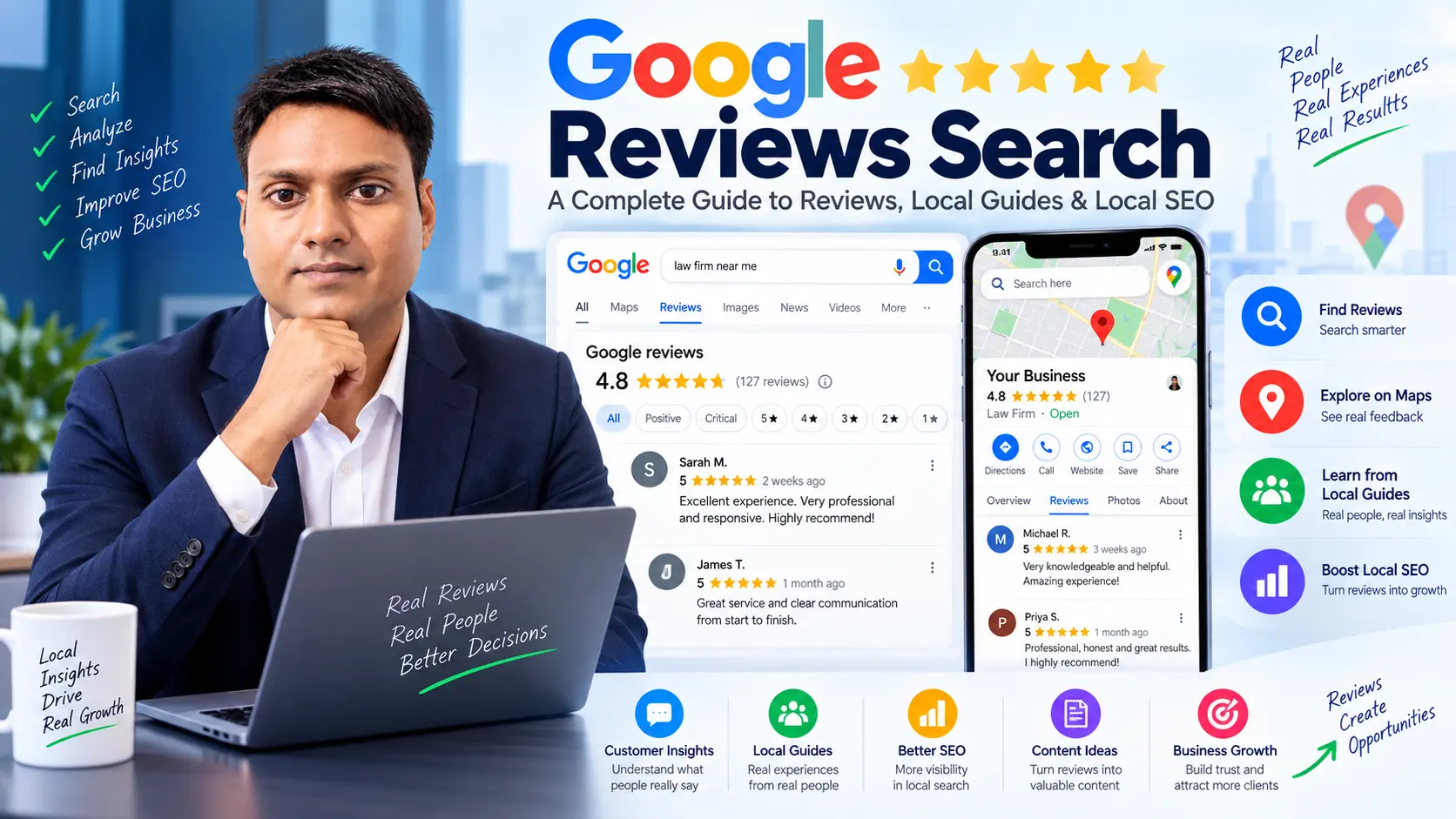
Google reviews are much more than a star rating beside a business name. When I research local SEO, I use reviews as a source of customer language, service information, search intent, reputation signals and competitive research.
This guide explains how I approach Google Reviews Search as a practical research process, how I use Google Search and Google Maps, what I look for in customer feedback, how Local Guides fit into the ecosystem, and how review research can become useful SEO and content intelligence.
Professional service, clear communication and an easy process from start to finish.
Helpful staff, fast response and a service that matched what I expected.
What Is Google Reviews Search?
I use the term Google Reviews Search to describe the process of finding, reading and analyzing Google reviews through Google Search and Google Maps. It is not a claim that Google has one universal feature officially named "Google Reviews Search."
When people search for a local business, they are often trying to understand more than whether that business has four or five stars. They want to know what other people experienced, what the service was actually like, whether communication was good, whether the process was easy, and whether the business delivered what customers expected.
From an SEO perspective, those reviews can contain useful information that is difficult to obtain from a standard keyword list. Customers naturally describe services in their own language. They mention problems, expectations, locations, staff interactions, timing, communication, pricing discussions, process questions and outcomes.
That is why I treat review research as a form of customer-language research. I am not simply looking at the star rating. I am looking for recurring themes that can help me understand search intent and improve the information a website provides.
Reviews are user-generated content. I use them as research material, not as automatically verified facts about every statement made by every reviewer. A review can tell me what a customer reported experiencing; it does not automatically prove every underlying claim.
How I Find Google Reviews in Google Search
My first step is usually simple: I search for the actual business, service or location rather than beginning with assumptions about what customers should be saying.
Google Search can surface local business information, review scores, review content and links into Maps. The exact interface can change over time, so I focus on the underlying workflow rather than memorizing one particular button position.
Find the business
Search the actual business name, service or local entity in Google Search.
Open review information
Examine the Business Profile and available review information.
Read beyond the first few reviews
Look for repeated themes instead of relying on one unusually positive or negative comment.
Record useful patterns
Extract recurring customer language, service issues, questions and expectations.
I also compare the review information with the business website. If customers repeatedly discuss something that the website barely explains, that gap can become an SEO and user-experience opportunity.
How I Search Google Reviews in Google Maps
Google Maps is particularly useful when I want to understand the local context surrounding a business. Maps brings the business, location and user-generated information together in one environment.
I normally start with the business or place and then examine the available review information. I look beyond the average rating and pay attention to how customers describe their actual experiences.
Search the business or location
I begin with the real-world entity instead of starting with a generic SEO assumption.
Open the review information
I review the rating, review count and the customer feedback available on the profile.
Look beyond the first few comments
The first visible review is not necessarily representative of the complete customer experience.
Identify recurring themes
I record patterns that appear repeatedly across different customers and time periods.
One customer may describe a highly specific situation. That can still be useful, but I do not treat one unusual comment as a universal description of a business. I look for repetition, context and consistency.
What My Google Review Research Looks Like
I started working in digital marketing in 2012 and developed a strong specialization in legal SEO from 2015 onward. Over time, my SEO work expanded across technical SEO, WordPress, content architecture, local SEO, website performance and competitive search markets.
That experience changed how I look at reviews. I do not see them only as reputation content. I see them as a source of customer language that can be connected with search intent, website architecture, content strategy and local search.
What I Look for Inside Google Reviews
A review can contain several layers of information. I do not simply copy phrases into a keyword spreadsheet. I first try to understand what the customer was trying to accomplish.
I am particularly interested in repeated customer language. If several independent customers naturally describe the same service, process or problem using similar terminology, that tells me something about how the market understands the service.
Google Reviews Are a Customer-Language Database
One of the most useful aspects of review research is the language customers choose without being prompted by an SEO professional.
Website copy is often written from the business's perspective. Customers describe the same service differently. That difference matters because search behavior is based on the language and concepts people actually use.
What I extract from recurring review language
Research categoriesI don't copy customer reviews into website content as if they were original marketing material. I use recurring concepts and language as research input, then create original, useful content around the underlying customer need.
Google Review Scores Explained
The star rating is one of the most visible parts of a Business Profile, but it is only one component of the review picture.
Google states that the review score is the average of all ratings published on Google for that place or business. Google also notes that after a new review is published, the updated review score can take up to two weeks to appear.
A review score provides a useful summary of published ratings, but it does not explain why customers rated the business that way. That is why I always read the underlying review content.
What I examine alongside the score
- Review volume
- Recurring themes
- Service-specific comments
- Customer expectations
- Positive and negative patterns
- Business responses
What Is a Google Local Guide?
Google Local Guides are individuals who contribute information to Google Maps. Contributions can include reviews, photos, answers, edits, additions of missing places and other types of information.
Google describes Local Guides as a community of people who contribute knowledge to Maps. The program is for individuals, not businesses.
GUIDE
A contribution program, not a reviewer-verification system
I consider this distinction important. A Local Guide badge indicates participation and contribution level within Google's Local Guides program.
It does not automatically mean that every statement written by that person has been independently verified by Google.
Google Local Guide Levels and Points
Google awards points for different types of Maps contributions. The point structure can change, so I recommend checking Google's current documentation rather than treating a historical points chart as permanent.
| Contribution | Current points |
|---|---|
| Review | 10 points |
| Review over 200 characters | 10 bonus points |
| Rating | 1 point |
| Photo | 5 points |
| Video | 7 points |
| Edit | 5 points |
| Add a place | 15 points |
| Add a road | 15 points |
According to Google's current Local Guides documentation, Level 4 begins at 250 points and is where the Local Guides badge becomes available. Points and program qualifications can change, so the official Google documentation should be treated as the current reference.
Does a Local Guide Badge Mean the Review Is Verified?
No. I would not use the Local Guide badge as a shortcut for deciding that a review is automatically verified or independently confirmed.
The badge represents contribution level in the Local Guides program. It can tell you something about the contributor's participation in Google Maps, but it does not independently prove every claim contained in a particular review.
What the badge can indicate
- The person has reached the required Local Guide contribution level.
- The person has contributed qualifying content to Google Maps.
- The profile participates in the Local Guides ecosystem.
What the badge does not prove
- That every statement in the review is independently verified.
- That the reviewer is an expert in the subject.
- That the review represents every customer's experience.
Are Google Reviews Public?
Yes. Google states that reviews are public and that anonymous reviews cannot be posted. Public contribution information can also include information associated with the contributor's Google Maps activity.
This is important when I use reviews for research. I treat the material as publicly displayed user-generated content rather than as private customer research.
I use publicly available review information to understand patterns, not to expose or misuse personal information. A review should be analyzed in context and not treated as permission to republish private information elsewhere.
How I Evaluate a Google Review
I don't evaluate a review only by its star rating. I look at context first.
This approach prevents me from making a major mistake: taking one unusual review and turning it into a broad conclusion about an entire business.
How I Look for Potentially Suspicious Review Patterns
I am careful with this area. A review that looks unusual is not automatically fake, and I do not label a reviewer or business based on appearance alone.
Instead, I look for broader patterns that may justify additional investigation.
Repeated language
Multiple reviews using unusually similar wording can be worth examining more closely.
Sudden unusual volume
A sudden concentration of reviews may deserve contextual investigation rather than an immediate conclusion.
Generic content
Reviews with little meaningful detail can provide less useful customer insight than detailed experience-based reviews.
Conflicting context
A statement that conflicts with other available information should be researched rather than automatically accepted or rejected.
Google's policies address fake engagement, incentivized reviews, rating manipulation and other prohibited behavior. If a review appears suspicious, the appropriate response is to document the relevant evidence and use Google's reporting processes where appropriate.
What Google Does Not Allow With Reviews
This is especially important for businesses and SEO professionals. Google says reviews and other Maps contributions should reflect genuine experiences.
Businesses can
- Ask customers to leave genuine reviews.
- Provide a Google review link or QR code.
- Respond professionally to customer feedback.
- Value both positive and negative feedback.
Businesses should not
- Offer incentives in exchange for reviews.
- Selectively request only positive reviews.
- Pressure customers to use specific wording.
- Pay for reviews or review manipulation.
Google specifically states that incentives such as free or discounted goods or services in exchange for reviews, review changes or removal of negative reviews are prohibited.
How Google Reviews Connect With Local SEO
Reviews are part of the local search ecosystem, but I do not tell clients that simply getting more reviews guarantees a higher local ranking.
Google explains that local results are primarily influenced by relevance, distance and prominence. Reviews can contribute useful information about a business and its customer experience, but local ranking is not a simple "get more reviews and rank higher" formula.
I look at reviews alongside Business Profile information, website relevance, location, authority, citations, links, content quality, technical SEO and the actual search intent behind the query.
This distinction matters because SEO decisions become unreliable when one visible metric is treated as the entire ranking system.
How I Use Google Reviews for Search Intent Research
Search-volume tools can tell me that people search for a phrase. Reviews can help me understand what people actually care about after they choose a business.
That difference is valuable.
What do customers repeatedly ask?
Repeated questions can indicate missing information that deserves a clear answer.
What problems are customers solving?
The customer's problem can reveal the real intent behind a service search.
What does the customer expect?
Expectations can help shape service pages, FAQs and conversion-focused content.
Where does the experience become difficult?
Repeated friction points can reveal opportunities for better information and UX.
How I Use Competitor Google Reviews
Competitor reviews can be useful because they show what customers are discussing in the same market.
I do not use competitor reviews to copy their content. I use them to understand market expectations.
Categories I compare
Competitor researchFor example, if customers repeatedly discuss communication, availability, appointment scheduling, turnaround time or service explanations, I can investigate whether those topics are adequately covered on the website I am working on.
Turning Google Reviews Into Better Website Content
This is where review research becomes actionable.
I do not want to publish a page simply because a competitor has one. I want the page to answer questions that matter to the actual customer.
Reviews are research input. The finished website content should provide original information, clear explanations and useful answers rather than becoming a collection of copied customer comments.
Using Review Research for Local Landing Pages
I frequently think about local landing pages in terms of user intent rather than simply inserting a city name into a template.
If reviews repeatedly reveal that customers care about appointment timing, communication, service availability, a specific process or a particular type of problem, the local page should answer relevant questions around that topic when the information genuinely applies.
Useful local-page inputs
- Services customers actually discuss.
- Recurring questions.
- Common customer concerns.
- Location-specific context.
- Service expectations.
What I avoid
- Copying reviews into the page.
- Creating artificial city-page templates.
- Making unsupported local claims.
- Repeating keywords without useful information.
- Publishing thin location pages.
How Google Review Research Fits Into My Legal SEO Work
Legal SEO requires additional caution because the subject matter can involve highly consequential decisions.
I have worked with legal SEO since 2015, and I approach reviews as research rather than as a replacement for legal expertise.
For example, reviews may reveal recurring questions around communication, case updates, responsiveness, consultation experience, explanation of services or other customer-experience topics.
Those observations can inform website UX and content planning, but they should never be turned into unsupported legal claims.
Customer language can inform content strategy, but factual legal information should be independently researched and reviewed for accuracy. A review is not an authoritative legal source.
Google Reviews Are Useful Beyond Restaurants
Review research is often associated with restaurants and hospitality, but the methodology applies to many local industries.
Law firms
Communication, consultation experience, responsiveness and service-specific expectations.
Financial advisors
Communication, education, service experience and client relationship themes.
Home services
Scheduling, technician experience, pricing discussions and service quality.
Local retail
Product experience, availability, staff interaction and purchasing friction.
How I Would Audit a Business's Google Reviews
If I were starting a local SEO project today, I would not simply record the average rating and move on.
I would build a structured review research sheet and organize recurring observations into categories.
Why Business Responses to Reviews Matter
A business response is another public communication point. I do not view it simply as an opportunity to insert keywords.
A useful response should acknowledge the customer's experience and communicate appropriately without exposing private information.
A useful response can
- Acknowledge the customer.
- Address the relevant experience.
- Show professional communication.
- Move sensitive discussion to a private channel where appropriate.
I would avoid
- Keyword-stuffing responses.
- Arguing with customers publicly.
- Revealing private customer information.
- Writing identical responses to every review.
What Google Reviews Can Tell Me
Customer expectations
What people expected before interacting with the business.
Customer language
How customers naturally describe services and experiences.
Recurring problems
Themes that appear repeatedly across multiple experiences.
Content opportunities
Questions and topics the website may need to explain better.
What Google Reviews Cannot Tell You
This is equally important.
Reviews cannot automatically prove
- That every factual statement is independently verified.
- That one review represents all customers.
- That a Local Guide is an expert in the subject.
- That a business has guaranteed SEO performance.
Reviews also do not replace
- Technical SEO analysis.
- Search-intent research.
- Website analytics.
- Business Profile optimization.
- Professional subject-matter review.
Is More Google Reviews Always Better?
I would not use a simple "more is always better" formula.
Review quantity is one part of the overall picture. Rating, recency, authenticity, customer experience and the business's overall reputation all matter in different ways.
Most importantly, businesses should not try to manufacture review volume through prohibited methods.
Build a business that creates genuine customer experiences worth talking about, make it easy for genuine customers to share feedback, and respond professionally to the feedback you receive.
My Practical Google Reviews SEO Workflow
When I incorporate review research into a local SEO project, I keep the workflow practical.
Google Reviews and SEO: Common Myths I Avoid
More reviews automatically means higher rankings
Local search is more complex than one review-count metric. Google describes relevance, distance and prominence as primary local ranking factors.
A Local Guide is a verified expert
The Local Guide badge represents contribution level, not independent subject-matter verification.
Every negative review should be removed
A negative review is not automatically a policy violation. Google provides reporting processes for reviews that violate its policies.
Review text should be copied into SEO content
I use review language as research input and create original content around the underlying customer need.
How Reviews Can Influence My Content Strategy
If I find a recurring topic in reviews, I ask a simple question: Is the website already answering this well?
If the answer is no, the next step is not automatically to create another 2,000-word article. Sometimes the correct solution is much smaller.
Improve an existing service page
Add missing information when the topic belongs naturally on the existing page.
Add an FAQ
Use a focused FAQ when the recurring question has a clear, useful answer.
Create a supporting guide
Build a dedicated resource when the topic deserves substantial explanation.
Improve website UX
Sometimes the information exists but is difficult for users to find.
Sometimes the SEO Problem Is Actually a Website Problem
This is something I see repeatedly in SEO work.
A business may think it needs more content because competitors have more pages. But review research can reveal that the actual problem is that customers cannot quickly find basic information.
If customers repeatedly ask about services, pricing expectations, scheduling, locations, communication or process, the solution may be better information architecture rather than another generic article.
Sometimes the correct SEO improvement is better information architecture, clearer UX, stronger service explanations or better technical implementation — not simply publishing more words.
What My Hands-On SEO Experience Has Taught Me About Reviews
I started working in digital marketing in 2012. My specialization in legal SEO developed from 2015 onward, and my work has expanded across technical SEO, WordPress, content architecture, local SEO, website performance and competitive search markets.
That experience has changed how I look at reviews.
I don't see a review as a magical SEO signal that can be switched on and off. I see it as a piece of public customer-generated information that can reveal how people experience a business.
That information becomes much more useful when I connect it with the website, the search query, the service being offered, the technical foundation and the customer journey.
I want to understand the search result, the Business Profile, the website, the content, the technical foundation and the customer journey together — not analyze each one in isolation.
A Practical Google Review Process for Local Businesses
If you own or manage a local business, I would keep the process simple.
Google allows businesses to ask customers to leave genuine reviews, including through a Google review link or QR code. The important distinction is that the business should not manipulate the rating, review content or participation through incentives.
How I Would Present Review Research to a Client
I would not send a client a spreadsheet containing hundreds of copied reviews and call that SEO research.
I prefer to turn the research into decisions.
What customers repeatedly discuss
Summarize the strongest recurring themes.
What the website does not explain
Identify missing or difficult-to-find information.
What should change
Recommend a page, section, UX improvement or content update.
Why the change matters
Connect the recommendation to customer intent and business goals.
Google Reviews Search FAQs
Google Reviews Search is a practical term for the process of finding and analyzing Google reviews through Google Search and Google Maps. It is not a claim that Google has one universal feature officially named "Google Reviews Search."
Google’s review interfaces can change, and available review browsing or filtering functionality can vary. I recommend using the current Google Search or Maps interface available to you rather than relying on an old interface description. For SEO research, I also manually review multiple comments to identify recurring language and themes.
Google reviews are public, and reviewer information can be visible as part of public Maps contributions. However, the available search and filtering experience can vary. I would not assume that every account or historical review can be located through a universal reviewer-name search.
Google reviews can appear with local businesses and places in Google Search and Google Maps. The exact presentation depends on Google's current interface and the type of business or place.
Yes. Google states that reviews are public and that anonymous reviews cannot be posted.
A Local Guide is an individual who contributes information to Google Maps through activities such as reviews, photos, answers, edits and other contributions.
The Local Guide badge indicates that the contributor has reached the required contribution level in Google's Local Guides program. Google currently awards the Local Guides badge at Level 4 and above.
No. The badge represents contribution level. It should not be interpreted as independent verification of every claim made in a review.
Google's current documentation lists 10 points for a review, plus a 10-point bonus when the review exceeds 200 characters. Google can change the points system, so its current help documentation should be used as the authoritative reference.
Google states that the review score is the average of all ratings published on Google for that place or business.
Google states that after someone leaves a new review, it may take up to two weeks for the updated review score to appear.
Yes. Google allows businesses to ask customers to leave genuine reviews and provides methods such as review links and QR codes.
No. Google prohibits incentives such as free or discounted goods or services in exchange for posting, changing or removing reviews.
Reviews are part of the local search ecosystem, but I would not describe them as a guaranteed ranking lever. Google explains that local results primarily consider relevance, distance and prominence.
Responding professionally to reviews can show customers that their feedback matters. Responses should be useful and appropriate rather than keyword-stuffed or argumentative.
Businesses can report reviews that they believe violate Google's policies. Google states that only reviews that violate its policies are eligible for removal. A review should not be reported simply because a business dislikes it.
I use recurring customer language as research input. I look for repeated services, problems, questions, expectations, locations and terminology, then compare those themes with the website and search intent.
I compare recurring customer themes across relevant competitors. The goal is to understand market expectations, not copy competitor reviews or content.
I would not use that formula. Review quantity is only one part of the overall picture. Genuine customer experiences, rating, review content, recency and business reputation all provide different information.
Do not immediately label the reviews as fake. Document the relevant pattern, compare the broader context and, where appropriate, use Google's reporting process for content that appears to violate its policies.
Final Thoughts: How I Use Google Reviews Search
Google reviews are easy to underestimate.
At first glance, they look like a star rating and a collection of customer comments. When I analyze them as part of a broader local SEO project, I see much more information: customer vocabulary, service expectations, recurring problems, communication patterns, competitive differences and potential content opportunities.
Local Guides add another layer of context because they represent people who actively contribute information to Google Maps. But I don't confuse contribution level with independent verification.
I also don't use reviews as a shortcut to promising rankings. Local SEO is a broader system involving relevance, distance, prominence, website relevance, Business Profile information, authority, citations, technical SEO and the actual search intent behind the query.
The most useful approach is to connect the pieces.
I want to understand what customers are saying, what the website currently explains, what the searcher is actually trying to find, and whether the technical and content foundation supports that journey.
That is how I use Google Reviews Search: not as a gimmick, but as another research layer that can help me make better SEO and website decisions.
Official Google Sources
Google changes its products and policies over time. These are the official Google resources I use as references for the factual portions of this guide.
Google Maps & Business Profile
- Google Maps — Find local results
- Google Maps — About Local Guides
- Google Maps — Local Guide points, levels and badging
- Google Maps — Contribute and earn points
- Google Maps — Local Guides community guidelines
- Google Maps — User-generated content policy
- Google Business Profile — Review scores
- Google Business Profile — Tips to get more reviews
- Google Maps — Add, edit or delete reviews
- Google Business Profile — Prohibited and restricted content
- Google Business Profile — Report inappropriate reviews
- Google Maps — Badges
Want to Turn Review Research Into SEO Strategy?
I work directly on SEO, WordPress, technical SEO, local search, content architecture and website performance. If your business has strong customer feedback but the website is not reflecting what customers actually search for and need, review research can become one part of a broader SEO strategy.
The goal is not simply to get more traffic. The goal is to build a website and search strategy that connects what people search for with useful information and a stronger customer journey.
Discuss Your SEO Project →